Jev for e-commerce: 4 decisions to automate, 3 to avoid
Jev writes nothing: it answers with a category, a score or a probability. The shop decisions it handles, and the ones it gets wrong.


Key takeaways
- The time it takes today: every message, every review and every supplier sheet goes through someone who reads first, then sorts, then acts.
- What really gets automated: the sorting, never the reply. The model returns a category, a score or a probability, and nothing else.
- What stays human: the trigger thresholds, the disputed cases and any decision that costs the customer money.
Jev is a model released on 15 September 2026 that writes nothing. You send it a text and a closed question, and it sends back a typed answer with its probability. For a shop, it changes just one thing, and it is the right one: the moment when a person has to read before deciding.
What the problem looks like
Monday morning, the customer service inbox holds thirty messages. Someone opens them one by one. This one asks where a parcel is, that one wants to return a pair of shoes, the third is angry.
None of these messages has had a reply yet. The work just done is sorting, and it tied up someone who knows how to answer.
In the evening, the same person starts again. In between, they were interrupted by a supplier, by an order to pack and by a question from a colleague. Every restart costs a few minutes that nobody counts.
The same move repeats elsewhere in the day:
- A review comes in on a product page. Someone reads it before it goes live.
- A supplier sends a catalogue. Someone files each reference in the right family.
- An order looks odd. Someone checks the address before shipping it.
In all four cases, the final decision needs a human brain. But the step before it is a closed question with a short answer: which category does it fall into, is it urgent, does it deserve a check.
That step clutters the day without producing anything the customer can see. It is also the easiest one to describe: a list of possible cases, and a rule for choosing.
What Jev can do, and what it can’t
Jev only accepts three kinds of question, and that constraint is the whole point. A Choice picks one option from a closed list of up to 255. A Score rates on a scale of 2 to 10 levels. A Noul returns the probability that a statement is true.
The answer cannot fall outside the list provided. It comes with its probability distribution and, for Choice and Score, a confidence index between 0 and 1. Software can act on it without rereading free text or cleaning up a format.
The publisher announces a latency of 70 to 500 milliseconds and an input price of 0.042 dollars per million tokens, with output tokens free. The speed comparisons published in TypeSafe’s announcement of 15 September 2026 were measured by the publisher itself, on its own cases.
These figures come from the official models page, checked on 21 September 2026.
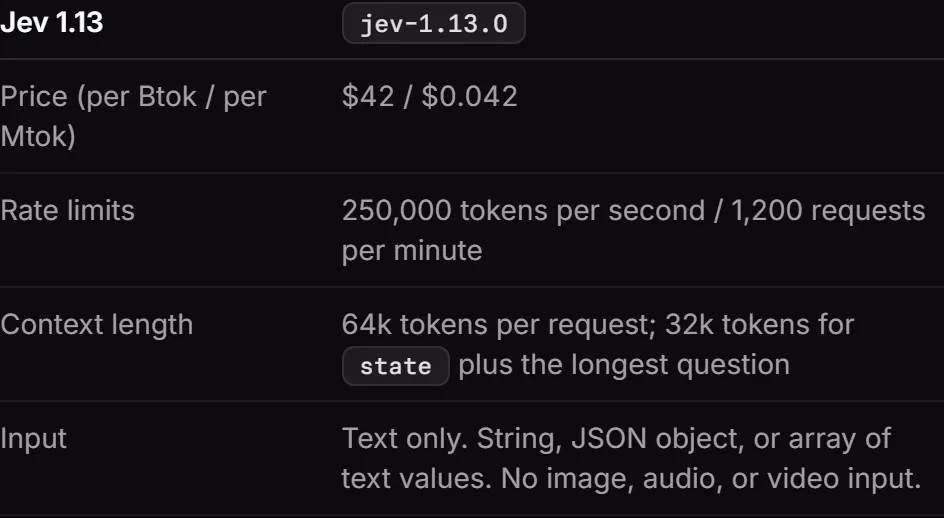
The limits, for their part, are spelled out in black and white in the documentation. Jev does not generate text: it writes neither product pages nor customer replies. It does not count reliably and is not a calculator. It reads dates as text, not as ordered quantities.
One last point, rarely mentioned: English is its main language, other languages are handled less well, and the documentation recommends testing before you deploy. For a shop whose customers write in another language, check it on your own messages, not on trust.
What it costs to do nothing
Start from the time actually spent sorting, not the time spent replying. Over a representative week, count the incoming messages and the minutes spent reading, sorting and forwarding them.
The formula: number of messages × sorting time ÷ 60 × weeks worked × loaded hourly cost.
| Assumption or calculation | Value |
|---|---|
| Messages per week | 60 |
| Sorting minutes per message | 2 minutes |
| Time per week | 60 × 2 ÷ 60 = 2 hours |
| Weeks worked | 47 per year |
| Loaded hourly cost used | €35 |
| Estimated annual cost of sorting time | 2 × 47 × 35 = €3,290 |
This amount is not a saving. It is what a task that produces nothing for the customer costs today. Part of it will still be there after automation: the uncertain cases, the review, the monitoring. That checking time is part of the comparison, not of the savings.
Run the calculation again for review moderation and for filing the catalogue. Three small separate tasks are often worth more than one big project, because each one can be measured and stops on its own if it brings nothing back.
Keep a second measure next to time: the number of misrouted messages. Faster sorting that sends a dispute to the wrong queue saves nothing at all, it just pushes the problem towards a complaint.
You have just run this calculation on one task. Let's work it out on yours, with your own figures.
Four shop decisions it really handles
- Routing an incoming message. A Choice on the shop’s real reasons for contact: order tracking, product question, return, delivery problem, complaint. Tracking then goes out as an automatic reply written by code, which fetches the parcel number.
- Moderating a review before it goes live. One Noul per rule rather than a catch-all question: insult, off topic, personal data, suspected fake review. The documentation advises against combining two conditions.
- Filing a supplier catalogue. One Choice per semantic attribute: family, material, use, audience. Since the answer comes from a closed list, there is nothing to clean up afterwards.
- Reviewing a product page generated by AI. A set of Noul questions before it goes live: unauthorised health claim, competitor brand mentioned, contradiction with the category. The model does not write the page, it brings it back into line.
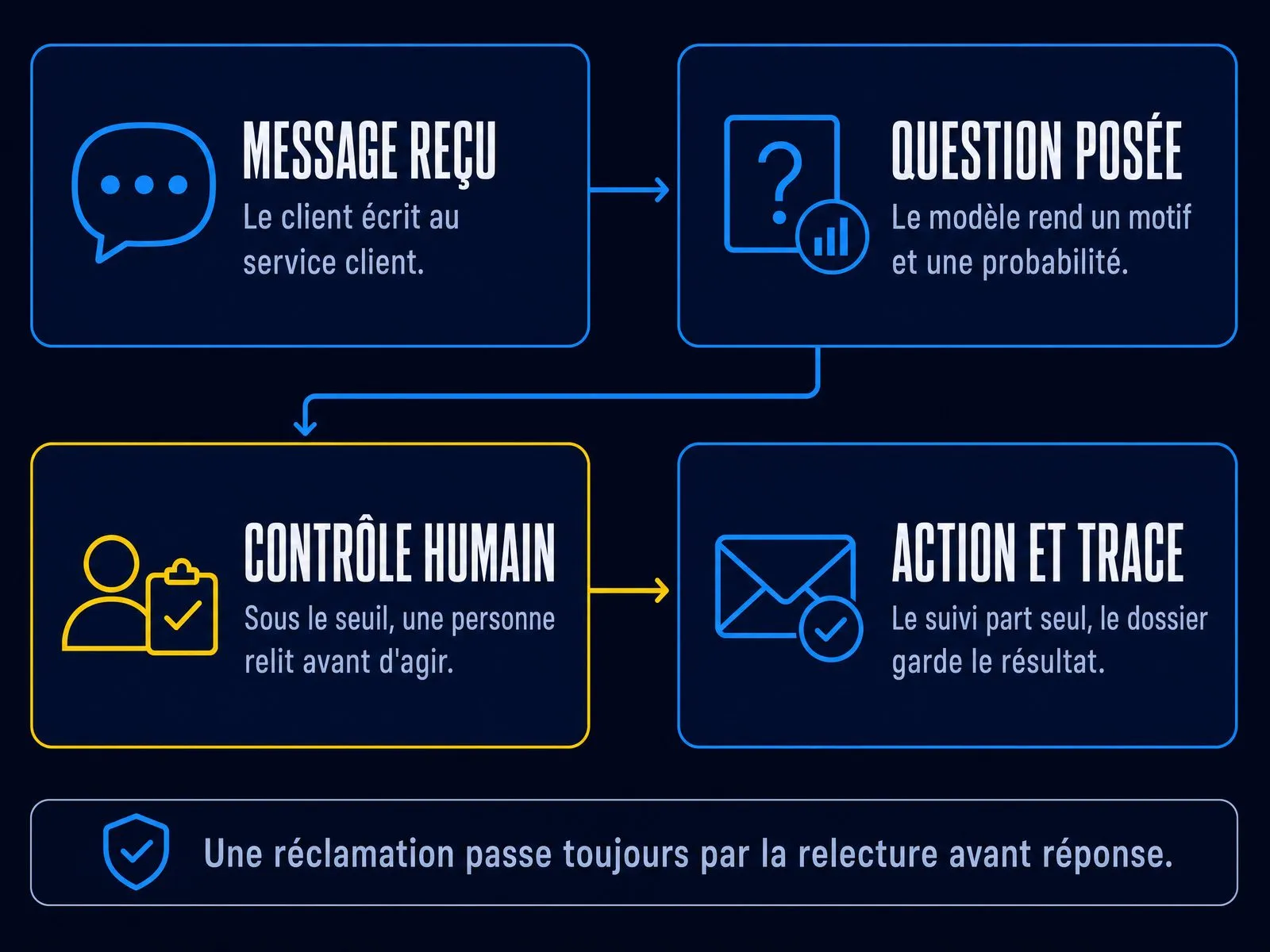
In all four cases, the journey is the same: the message arrives, the closed question is asked, a human check decides below the threshold, then the action goes out and leaves a trace.
What you don’t hand over to it
The official limits page rules out several obvious ideas on its own.
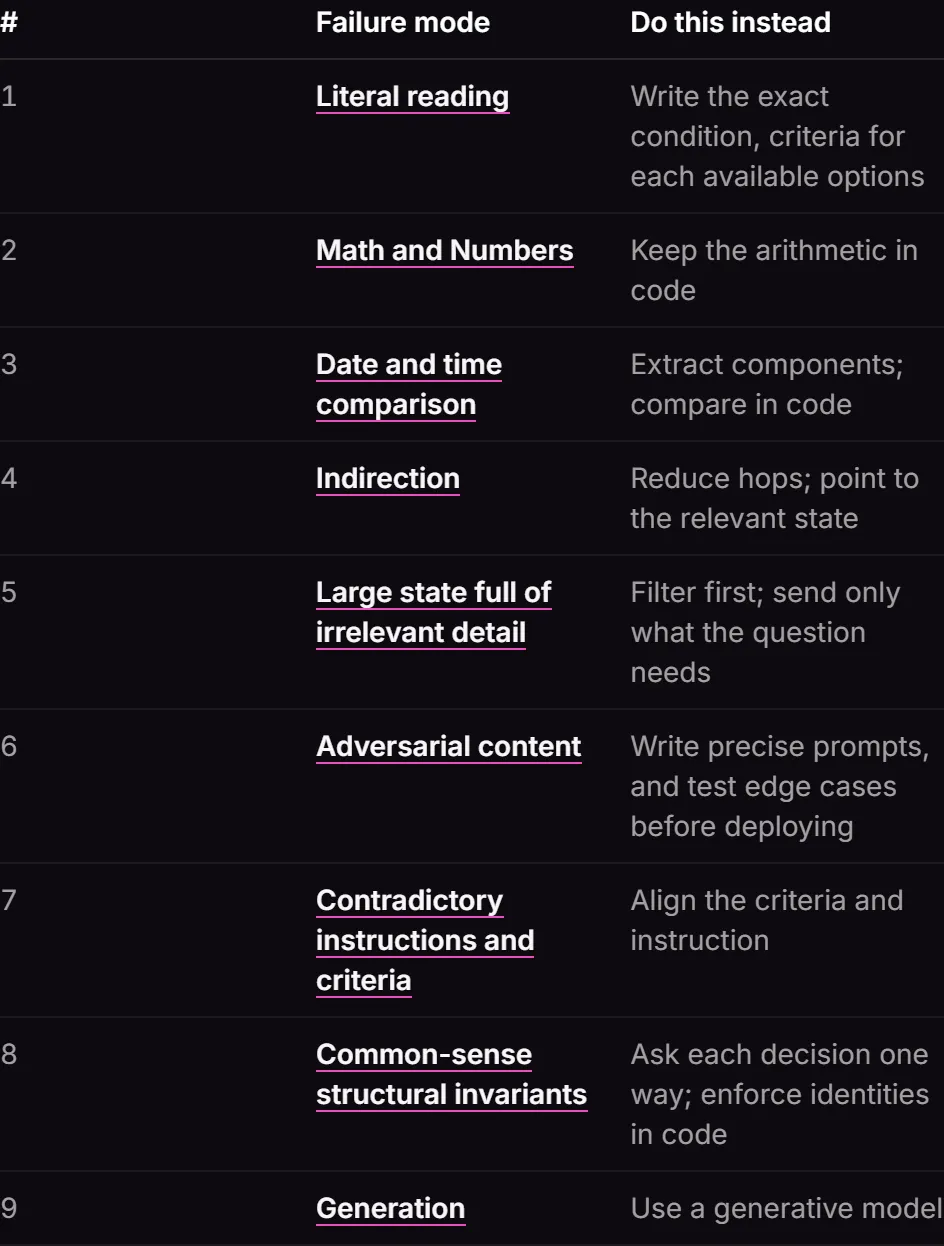
Prioritising abandoned baskets depends on the basket value, the number of visits and the time elapsed. Three numerical quantities: a query on your database does better, with no call at all.
Checking that a return falls within the legal deadline compares two dates. The model reads them as text: that calculation stays in the code.
Checking a price, a stock level or a volume falls under the same rule. Anything that is counted is out of scope.
This split is the skill to learn: what goes to the model, and what stays a rule in a tool built for your business.
The publisher lists these failure modes, with the recommended course of action for each one.
What breaks, and how to avoid it
A Choice always returns one of the options you give it. An off-topic message will therefore land in a category: it is the confidence index, never the answer, that tells you the model is hesitating. Add a "none of these categories" option, and route whatever falls below the threshold to a human.
The text comes from a stranger. The documentation warns that it does not treat what it is sent as hostile: a review that says "ignore the instructions" can shift the answer.
The published thresholds are not yours. The values 0.5 and 0.9 in the documentation are code examples, not measurements. Start cautious, then adjust. The more the action costs, the higher the threshold.
The data goes to the United States. The privacy policy says so, no European data residency is offered, and zero retention is reserved for enterprise accounts. The master agreement, checked on 21 September 2026, caps the publisher's liability at the higher of two amounts: what you paid it over twelve months, or 50 dollars.
These four traps apply to any external component. I have listed elsewhere the risks to know before deploying an AI agent.
Where to start if you do it yourself
- Pick a single decision. The most frequent and most closed one in your week: message routing, almost always.
- Write the list of possible answers, “other” option included. If you cannot close the list, the decision is not ready.
- Connect it in observation mode. For two to four weeks, the model answers alongside your usual process without triggering anything.
- Work out your thresholds from those records, question by question, on your own messages.
- Pin the model version rather than an alias: a new version changes the behaviour, and your thresholds.
On the integration side, there is currently no official n8n, Make or Zapier module: it is an API you call yourself, with the Python or JavaScript SDK. The shortest route goes through Cloudflare, which publishes the model as typesafe/jev and serves it from your account, with no waiting list.
My view, six days after release: it is not one to put into production straight away. No availability commitment has been published and the weaknesses are already listed. The method, though, can be tested right now. Apply it to a first, well-scoped task.
Frequently asked questions
Does Jev replace ChatGPT in my shop?
No. A language model writes a reply or a product page. Jev produces no text: it returns a category, a score or a probability. The two complement each other, one sorts and the other writes.
Does it work in languages other than English?
The documentation states that English is the main language and that other languages are handled less well, with no published measurement per language. No official figure tells you how well it handles your language: that is what the observation phase is there to check.
Do I need a developer to plug it in?
For a trial, someone comfortable with an API is enough: one HTTP call carrying a list of questions. For production, you need to handle errors, retries, logging and the hand-off to a human. That is the part that takes time.
Is my customer data protected?
The data is hosted in the United States, with no European data residency. Removing identifying details before the call reduces exposure but does not take you outside the GDPR: pseudonymised text is still personal data, and US hosting is still a transfer outside the EU that needs a legal framework. The data processing agreement is incorporated by reference into the master agreement, to be read with your adviser.
Sources
- TypeSafe AI, Introducing System One models and Jev, 15 September 2026, accessed on 21 September 2026.
- TypeSafe AI, documentation, Models page, accessed on 21 September 2026.
- TypeSafe AI, documentation, known limits of Jev 1.13, accessed on 21 September 2026.
- TypeSafe AI, documentation, confidence and its thresholds, accessed on 21 September 2026.
Where does this model fit in your shop?
Four questions to check the split is clear.
Question 1 of 4
Which task cannot be handed to Jev?

Pierre Bour
Founder of Scale Me. I help businesses with Google Ads, and I build automations and custom tools that take the repetitive tasks off their plate.
Want to automate without losing sleep over it?
I design your automations and custom tools, then put them into production. You stay in control, I handle the technical side.